
A servo gearbox is a bigger servo, not a different device. Inside is a multi-turn servo driven by the same pulse at 50 Hz; outside is a gear reduction that divides the travel, multiplies the torque and puts the whole load on a shaft running in bearings. The wiring is still three wires. Only the maths changes.
ServoCity Stingray and Shark gearboxes are built around an unmodified off-the-shelf servo. The servo drives a pinion, the pinion drives an aluminium output gear, and the gear is fixed to a steel hub shaft supported by a pair of ball bearings. The load never touches the servo's splined shaft: axial and radial forces end up in the gearbox body.
The position loop is still the servo's own, with its internal potentiometer. That is why the pulse you send to the gearbox is exactly the one you would send to the bare servo — if you have never driven a servo, start with the guide How to control a hobby servo motor.
Every gearbox carries its ratio in its name: Stingray-5 is a 5:1, Shark-9 is a 9:1. Everything else follows from one division. The goBILDA servo in the Stingray covers 1800° (five turns) over the 500–2500 µs range; the Hitec HSR-M9382TH in the Shark covers 2520° (seven turns) over the 800–2200 µs range. At the output you get that travel divided by the ratio.
The higher the ratio, the slower, stronger and finer the gearbox: each microsecond of pulse moves the shaft less, so the same noise on the signal produces a smaller angular error. Choose the highest ratio that still gives your mechanism the travel and speed it needs.
To command the shaft in degrees you need just one number: the model's degrees per microsecond. It is 0.9 °/µs divided by the ratio on the Stingray and 1.8 °/µs divided by the ratio on the Shark. The centre of travel is always at 1500 µs.
pulse_us = 1500 + (output_angle - travel / 2) / deg_per_us

// Stingray-5:  travel 360°, 0.18 °/us  →  90° = 1500 + (90 - 180) / 0.18 = 1000 us
// Shark-7: travel 360°, 0.257 °/us → 90° = 1500 + (90 - 180) / 0.257 = 1150 usThe body is the same — M4 threaded holes on the goBILDA grid on every side, and a hub with an 8 mm REX bore that can drive a shaft or act as a cable pass-through — and the servo inside is what changes. Stingray gearboxes use the goBILDA 5-turn servo with a brushed motor and already accept 4.8 V; Shark gearboxes use the Hitec HSR-M9382TH brushless servo with titanium gears, which gives more torque but needs at least 6 V and has a narrower pulse range.
| Stingray (3215) | Shark (3216) | |
|---|---|---|
| Internal servo | goBILDA 2000 Series 5-Turn, dual mode | Hitec HSR-M9382TH, brushless |
| PWM range (position) | 500 – 2500 µs | 800 – 2200 µs |
| Internal servo travel | 1800° (5 turns) | 2520° (7 turns) |
| Degrees per µs, at output | 0.9 / ratio | 1.8 / ratio |
| Voltage | 4.8 – 8.4 V | 6.0 – 8.4 V |
| Stall current | 2.0 – 3.0 A | 2.7 A |
| Dead band | 4 µs | 1 µs |
| Pulse amplitude | 3 – 5 V | 3 – 5 V |
| Direction with increasing pulse | Anticlockwise | Anticlockwise |
| Mode programmer | 3102-0001-0001 | Hitec DPC-11 |
| Model | Ratio | Travel | °/µs | Torque at 7.4 V | Speed at 7.4 V |
|---|---|---|---|---|---|
| Stingray-2 | 2:1 | 900° | 0.45 | 50.4 kg·cm | 0.34 s/60° · 30 rpm |
| Stingray-3 | 3:1 | 600° | 0.30 | 75.6 kg·cm | 0.51 s/60° · 20 rpm |
| Stingray-4 | 4:1 | 450° | 0.225 | 100.8 kg·cm | 0.68 s/60° · 15 rpm |
| Stingray-5 | 5:1 | 360° | 0.18 | 126.0 kg·cm | 0.85 s/60° · 12 rpm |
| Stingray-7 | 7:1 | 257° | 0.129 | 176.4 kg·cm | 1.19 s/60° · 8.6 rpm |
| Stingray-9 | 9:1 | 200° | 0.10 | 226.8 kg·cm | 1.53 s/60° · 6.7 rpm |
| Model | Ratio | Travel | °/µs | Stall torque | Speed at 7.4 V |
|---|---|---|---|---|---|
| Shark-2 | 2:1 | 1260° | 0.90 | 68 kg·cm | 0.28 s/60° · 36 rpm |
| Shark-3 | 3:1 | 840° | 0.60 | 102 kg·cm | 0.42 s/60° · 24 rpm |
| Shark-4 | 4:1 | 630° | 0.45 | 136 kg·cm | 0.56 s/60° · 18 rpm |
| Shark-5 | 5:1 | 504° | 0.36 | 170 kg·cm | 0.70 s/60° · 14 rpm |
| Shark-7 | 7:1 | 360° | 0.257 | 238 kg·cm | 0.98 s/60° · 10 rpm |
| Shark-9 | 9:1 | 280° | 0.20 | 306 kg·cm | 1.26 s/60° · 8 rpm |
The servo inside the gearbox is dual mode. In position (feedback) mode the pulse is an angle: the gearbox goes there and stays there, resisting the load. In continuous mode the pulse becomes a speed with a direction: 1500 µs means stop, shorter and longer pulses turn the shaft either way, with no end stops.
You can buy it in one mode and change it whenever you like, without opening it: Stingray gearboxes use the 3102 Series Dual Mode Servo Programmer (3102-0001-0001), Shark gearboxes the Hitec DPC-11 programmer. In continuous rotation the Stingray works between 900 and 2100 µs.
| Pulse | Position mode (Stingray-5) | Continuous mode (Stingray) |
|---|---|---|
| 500 µs | 0° — one end of travel | Outside the continuous range (900 – 2100 µs) |
| 900 µs | 72° | Full speed, clockwise |
| 1000 µs | 90° | Fast, clockwise |
| 1500 µs | 180° — centre | Stop |
| 2000 µs | 270° | Fast, anticlockwise |
| 2100 µs | 288° | Full speed, anticlockwise |
| 2500 µs | 360° — other end of travel | Outside the continuous range (900 – 2100 µs) |
Continuous mode is for when something else knows the position: a limit switch, an external encoder, a camera, or an operator with a radio transmitter. For a conveyor, a winch or a slow, very strong drive wheel it is the right choice; for a joint that must always return to the same angle, stay in position mode.
The connector is the classic three-pin servo plug: signal, V+ and ground. The signal accepts 3 to 5 V, so it can come straight from an Arduino, ESP32, Raspberry Pi, an R/C receiver or a REV Control Hub. The problem, as always with servos, is power — only here it is three times bigger.
A stalled gearbox draws 2 to 3 A, and it gets there every time it lifts a load close to its limit. You need a dedicated power supply or battery: 4.8–8.4 V for the Stingray, 6.0–8.4 V for the Shark. A 2S LiPo (7.4 V nominal, 8.4 V fully charged) sits inside both ranges and gives the catalogue's maximum torque and speed.
You use the usual Servo library, with two precautions. First: pass the gearbox's full range to attach(), otherwise the library clips the pulses to 544–2400 µs and you lose part of the Stingray's travel. Second: forget write() in degrees, which spreads 0–180 across the pulse range rather than across the shaft's real degrees. Work in microseconds and do the conversion yourself.
// Servo gearbox on D9, powered at 7.4 V with its ground
// tied to the Arduino GND.

#include <Servo.h>

// --- pick the family and the ratio ---
const int   MIN_US   = 500;    // Stingray: 500   Shark: 800
const int   MAX_US   = 2500;   // Stingray: 2500  Shark: 2200
const float SERVO_DEG = 1800.0; // Stingray: 1800  Shark: 2520
const float RATIO    = 5.0;    // Stingray-5 = 5:1

const float TRAVEL = SERVO_DEG / RATIO;               // 360 degrees
const float DEG_PER_US = TRAVEL / (MAX_US - MIN_US);  // 0.18

Servo gearbox;

// Output shaft angle (0...TRAVEL) -> pulse in us.
int usForDeg(float deg) {
  if (deg < 0) deg = 0;
  if (deg > TRAVEL) deg = TRAVEL;            // never past the end stop
  return MIN_US + (int)(deg / DEG_PER_US + 0.5);
}

void setup() {
  gearbox.attach(9, MIN_US, MAX_US);         // the full travel
  gearbox.writeMicroseconds(usForDeg(TRAVEL / 2)); // start at centre
  delay(2000);                              // it is slow: give it time
}

void loop() {
  gearbox.writeMicroseconds(usForDeg(90));   // 1000 us
  delay(3000);
  gearbox.writeMicroseconds(usForDeg(270));  // 2000 us
  delay(3000);
}
The waiting times are not a detail. A Stingray-5 takes 0.85 s per 60°: from one end of its 360° to the other is more than five seconds. If you send the next position before the gearbox has arrived, the motion comes out jerky. For smooth moves, approach the target in small steps:
// Moves the shaft towards 'target' degrees at constant speed.
float current = TRAVEL / 2;

void moveTo(float target, float degPerSec) {
  const int STEP_MS = 20;                    // one PWM frame
  float step = degPerSec * STEP_MS / 1000.0;
  while (abs(target - current) > step) {
    current += (target > current) ? step : -step;
    gearbox.writeMicroseconds(usForDeg(current));
    delay(STEP_MS);
  }
  current = target;
  gearbox.writeMicroseconds(usForDeg(current));
}

// moveTo(300, 30);  // at 30 degrees/s, below the Stingray-5's 70 degrees/s
In continuous mode degrees no longer exist: the pulse is a signed speed around 1500 µs. Keep an eye on the dead band — 4 µs on the Stingray — and if the gearbox creeps slowly at 1500 µs, trim the stop point by a few microseconds instead of always sending 1500.
// Stingray in continuous rotation: 900...2100 us, 1500 = stop.
const int STOP_US = 1500;   // trim it if it moves at rest
const int SPAN_US = 600;    // 1500 +/- 600

// speed from -100 (clockwise, full) to +100 (anticlockwise, full).
void setSpeed(int speed) {
  speed = constrain(speed, -100, 100);
  gearbox.writeMicroseconds(STOP_US + speed * SPAN_US / 100);
}

setSpeed(50);    // half speed, anticlockwise
setSpeed(0);     // stop
setSpeed(-100); // full speed, clockwiseWith an accepted amplitude of 3 to 5 V, any 3.3 V output will do. On ESP32 the ESP32Servo library exposes the same attach(pin, min, max) and writeMicroseconds(): the sketch above runs almost unchanged. On Raspberry Pi avoid software PWM, which jitters by tens of microseconds — on a 0.9 °/µs Shark-2 that means whole degrees; use hardware PWM or a PCA9685 board at 50 Hz, which has the bonus of driving sixteen channels over I²C.
To a receiver, a servo gearbox is just another servo: it plugs straight into a channel and you drive it from the stick, with no Arduino and no code at all. It is the quickest way to build a hand-controlled arm, gripper, turret or winch, and it works with any radio that uses standard servo outputs, such as the ServoCity Element-4 radio (3113-0004-0001) with its Element receiver (3112-0006-0001).
The receiver generates the same 50 Hz frames as an Arduino, with two differences worth knowing. The first is the range: almost every transmitter sends 1000–2000 µs at full stick, while Stingrays accept 500–2500 µs. The second is power: the receiver passes V+ and ground to every channel, but it does not make any current — it takes it from the battery or BEC plugged into its bus.
With the standard 1000–2000 µs range, a gearbox in position mode only uses the middle of its travel. Raising the channel's end points on the transmitter helps, but only to about 900–2100 µs and only if your radio supports it.
The complete fix is the Servo Travel Tuner: it extends the travel of any RC radio. It plugs in between receiver and gearbox like an extension lead and stretches the output pulse out to 500–2500 µs, with separate centre, left and right adjustments. It works with any transmitter, even a basic one with no adjustable end points, and needs no programming.
| Pulse from the receiver | Stingray-5 · position | Shark-5 · position | Stingray · continuous |
|---|---|---|---|
| Standard · 1000 – 2000 µs | 180° (90° to 270°) | 360° | ≈ 83 % of top speed |
| Extended end points · ≈ 900 – 2100 µs | ≈ 216° | ≈ 432° | Full top speed |
| Servo Travel Tuner · up to 500 – 2500 µs | 360° — full travel | 504° (800 – 2200 µs) | Full top speed (900 – 2100 µs is enough) |
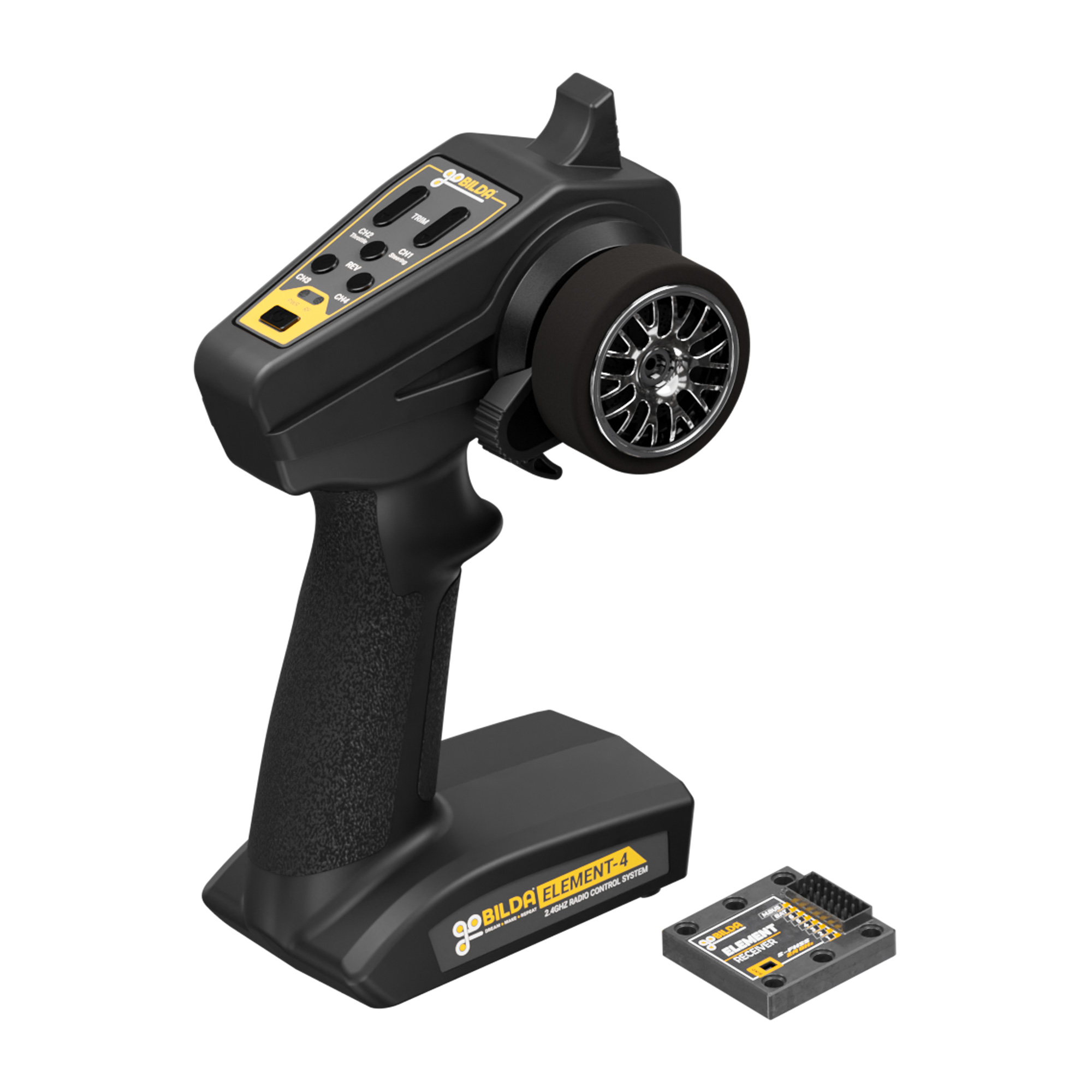
SKU 3113-0004-0001 · 4-channel 2.4 GHz pistol-grip radio, Element receiver included, range up to 400 m.
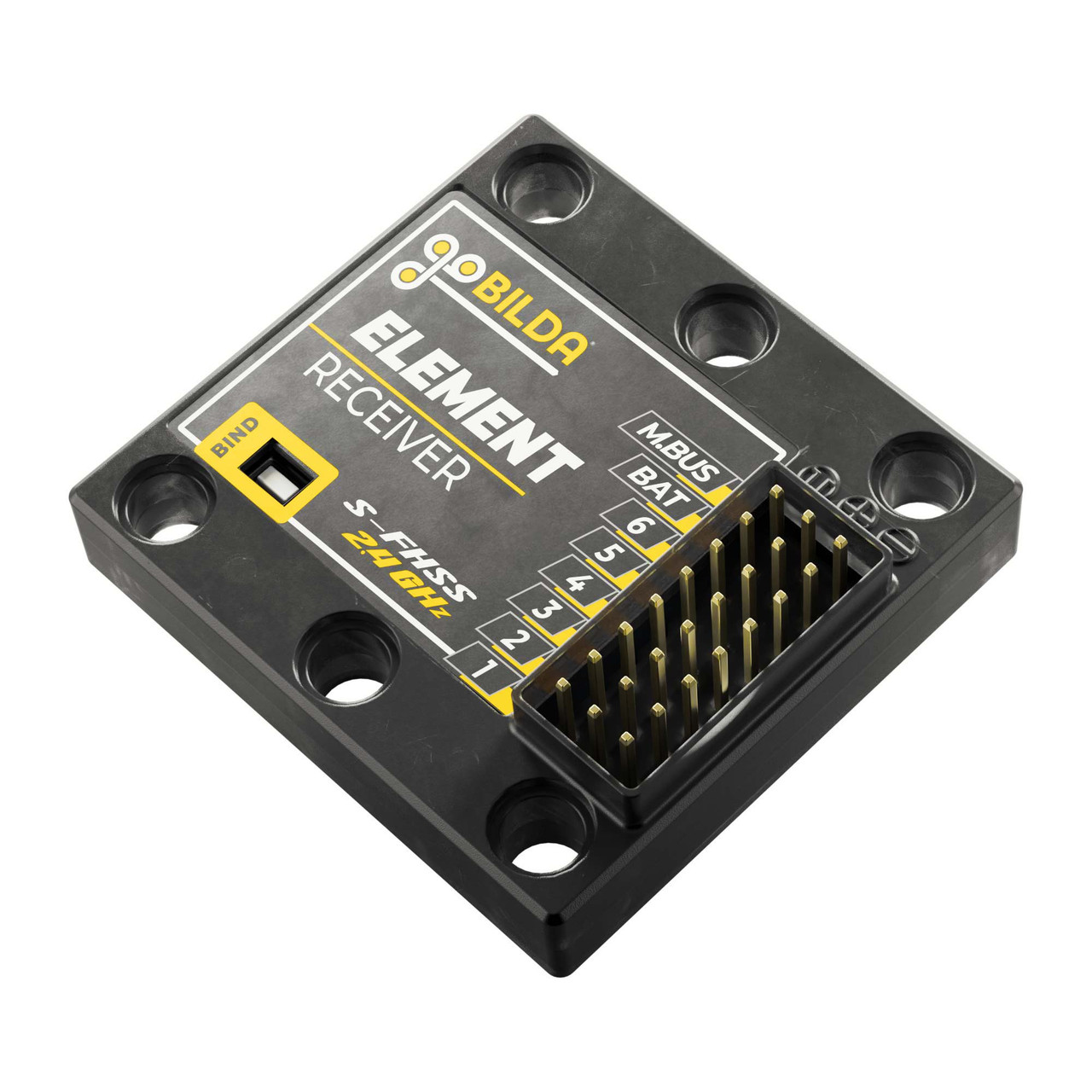
SKU 3112-0006-0001 · extra receiver for the Element-4 and Element-6, 3.5–7.4 V, M.BUS output.

Extends the travel of any RC radio: from 1000–2000 µs out to 500–2500 µs, full travel.
Two accessories solve almost every practical problem with gearboxes: the programmer switches the internal servo's mode and works as a servo tester without a single line of code; the Servo Travel Tuner widens or narrows the travel when your controller can't generate the full pulse range.

Works with the goBILDA servo inside the Stingray. It is powered by the included 4-cell battery tray; plug the gearbox into the programmer's servo header following the polarity printed on the board.
| Button | Position mode | Continuous mode |
|---|---|---|
| S ×1 | Automatic back-and-forth sweep — S LED flashes fast | |
| S ×2 | 3-point test — S LED flashes slowly | |
| L | Goes to the left end | Full speed to the left |
| P | Goes to centre | Stop |
| R | Goes to the right end | Full speed to the right |
| S ×3 | Leaves the test, LEDs switch off | |
The 3-point test is the quickest way to fit an arm: press P, the gearbox goes to mid-travel, and clamp the arm in that position. The mechanical centre then matches the 1500 µs in your code.
See the 3102 programmer
The Shark's HSR-M9382TH servo is programmed from a PC with the DPC-11 and Hitec's Windows software. Besides continuous mode it lets you set centre and left/right end points, direction of rotation, speed, dead band, soft start and fail safe — handy if the gearbox must move to a safe position when the signal is lost.
Many R/C transmitters and controllers only send 1000–2000 µs. On a Stingray, which wants 500–2500 µs, that means using half the travel: a Stingray-5 stops at 180° instead of 360°. The Travel Tuner plugs in inline like a servo extension and remaps the output pulse, up to 500–2500 µs, with no code and no reprogramming.
With Arduino, ESP32 or any controller that already outputs 500–2500 µs you don't need it: just use attach(pin, 500, 2500).
See the Servo Travel Tuner| Symptom | Typical cause | Fix |
|---|---|---|
| A Shark does not move at all | Supply below 6 V | Bring the voltage between 6.0 and 8.4 V |
| The controller resets when the gearbox starts | Supply sagging under 2–3 A, or servo powered from the board | Dedicated supply of at least 3 A, grounds joined |
| Covers only part of its travel | Library default limits (544–2400 µs) | attach(pin, 500, 2500) or (pin, 800, 2200) |
| Goes to a different angle from the one requested | Commanded with write() in degrees | Use writeMicroseconds() and the model's degrees per µs |
| Turns the opposite way to what you expect | Increasing pulse = anticlockwise | Invert in code: MIN_US + MAX_US − pulse |
| Spins endlessly instead of holding the angle | It is in continuous mode | Reprogram it to position with the 3102 or the DPC-11 |
| In continuous mode it creeps at 1500 µs | Stop point not perfectly centred | Trim STOP_US by a few µs |
| Jerky motion | New positions sent before it arrives | Speed ramp, or waits suited to the ratio |
| Buzzing and heat at standstill | Load close to stall torque | Higher ratio or a counterweight on the arm |
| With an RC radio it covers only half its travel | The receiver sends 1000–2000 µs, a Stingray wants 500–2500 µs | Servo Travel Tuner or wider end points |
| The receiver drops out when the gearbox moves | Receiver bus fed by a weak supply | 6 A BEC, or power the gearboxes directly |
| With RC the arm springs back to centre | Driven from a spring-centred stick in position mode | Use the throttle stick, a knob or a switch |
No. The signal is identical: a 50 Hz PWM pulse on three wires, with a 3 to 5 V logic level. Only the maths changes, because the reduction ratio divides the travel and speed of the internal servo and multiplies its torque.
The travel of the internal servo divided by the ratio. Stingray gearboxes use the goBILDA 5-turn servo (1800°): from 900° at 2:1 down to 200° at 9:1. Shark gearboxes use the 2520° Hitec HSR-M9382TH: from 1260° at 2:1 down to 280° at 9:1.
Stingray gearboxes run from 4.8 to 8.4 V, Shark gearboxes from 6 to 8.4 V. At stall they draw 2 to 3 A, so you need a power supply or battery rated for at least 3 A per gearbox, with its ground tied to the controller GND.
Yes. The internal servo is dual mode: with the 3102-0001-0001 programmer (Stingray) or the Hitec DPC-11 (Shark) it switches from position mode to continuous rotation, where the pulse sets speed and direction and 1500 µs means stop.
Because the Servo library spreads 0–180 across the pulse range, not across the real degrees of the output shaft. On a Stingray-5 the range covers 360°, so write(90) sends the output to 180°. Use writeMicroseconds() and convert from output degrees with the model's degrees per microsecond.
Yes. The accepted pulse amplitude is 3 to 5 V, so a 3.3 V output is enough. On ESP32 use the ESP32Servo library or the LEDC peripheral at 50 Hz; on Raspberry Pi prefer hardware PWM or a PCA9685 board, because software PWM jitters.
Yes. Plug the gearbox straight into a receiver channel: no microcontroller needed. Power the receiver bus from a BEC or battery inside the gearbox voltage range (6 V suits both Stingray and Shark). Receivers usually send 1000–2000 µs, so a Stingray uses about half its travel: widen the end points or add a Servo Travel Tuner to reach 500–2500 µs.
Live prices and availability from the shop. Click a gearbox for the full product page.
The signal is the easy part. The hard part is picking the right ratio between travel, speed and torque — and fixing the gearbox to a structure that can take the force it produces. Stingray and Shark mount directly on the goBILDA M4 grid, so the system's channels, brackets and shafts fit without adapters.
goBILDA 5-turn servo, 2:1 to 9:1: from 900° of travel to 227 kg·cm of torque
BrowseHitec brushless servo with titanium gears: up to 1260° or up to 306 kg·cm
BrowseExtends the travel of any RC radio out to 500–2500 µs: the full Stingray travel
ViewThe 3102 programmer to switch modes, servo extension leads and accessories
BrowseTravel, torque and speed are listed on every product page. Not sure which ratio your mechanism needs? Send us a sketch with weights and arm lengths: we answer with a part number, not a brochure.


